Namibia tour highlights
From the crimson red of Sossusvlei’s dunes to the wide blue skies over the country’s game-rich national parks, Namibia is a vibrate palette of colour.
Our Namibia adventure tours will take you through quintessential Namibian scenery: the ancient sand landscapes of the Namib Desert, the colonial towns of the coast and the wide savannahs of the national parks. Here are some of our top highlights of Namibia:
Sossusvlei
Sossusvlei’s burnished sand dunes are some of the highest and most spectacular in the world, with some stretching more than 300 metres tall – the tallest is affectionately known as 'Big Daddy'. Photographers will relish an early morning visit to photograph the dunes in the first rays of sunlight, as they glow a deep orange, or for sunset where the light changes to a scorched red. Very little water courses make their way here from the Tsauchab River valley, so the vegetation is sparse – but you may still be able to spot springbok and ostriches. On our Namibia Lodge Safari, our day in Sossusvlei will also see us continue on foot through the picturesque Sesriem Canyon, where pools of water attract a variety of birds and animals.
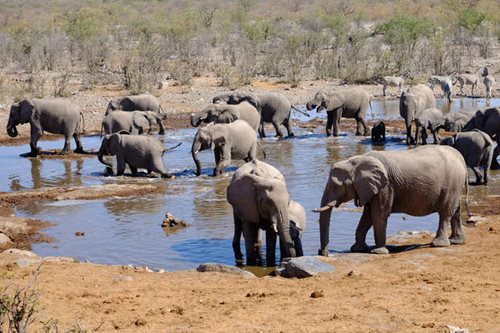
Etosha National Park
Considered one of Africa’s finest safari reserves, Etosha National Park is home to four of the Big Five African animals – though buffalo can be found elsewhere in Namibia at Waterberg Plateau. Etosha's arid habitats make it a particularly excellent destination for viewing animals that come to drink at the waterholes. The dry winter months are excellent for spotting rhinos, elephants and springbok.
Namib Desert
The Namib Desert is the oldest desert in the world, believed to date back as far as 80 million years. It stretches from Angola in the north along the entire coastline of Namibia and down to South Africa, with endless dunes and wide, flat salt pans that, despite the harsh environment, manage to support a variety of species from zebra to hardy beetles. Some of Namibia’s most unusual landscapes are courtesy of the Namib Desert, from the plunging inhospitable dunes of the Skeleton Coast to the white clay pan of Deadvlei, set among the dunes of Sossusvlei. The Namib is a great place for spotting some of Namibia’s desert-adapted wildlife, which is largely free-roaming. This includes Hartmann’s mountain zebras, black-backed jackals, cheetahs and elephants. We visit the Namib Desert on our Lodge Safari tour, or if you've got more time to explore Africa, check out our Namibia Lodge Safari + South Africa Garden Route tour.
Torra Conservancy
Rugged, remote and vast, the Torra Conservancy is one of the largest of its kind in Northern Naminbia. On our Upgraded - Highlights of Namibia tour, venture into the reserve by 4x4 vehicle, before joining a conservationist. They'll lead you in the footsteps of the endangered black rhinos which roam freely in this stunning landscape. This walking safari offers a much more intimate and once-in-a-lifetime experience, as we follow a lesser-visited route. This gives you ample opportunity to spot other wildlife in the area, including kudu (large woodland antelope), mountain zebras, oryx and giraffes.
Solo Travel in Namibia
Every one of Explore's Namibia holidays is suitable for solo travellers – in fact, you can expect that around half the group on each departure will be travelling solo. The precise number varies depending on which tour you choose, but you'll be in good company. Our small group holidays to Namibia are a great opportunity to meet like-minded people and share experiences along the way. We've answered the most frequently asked questions about travelling solo with Explore.
Best time to go to Namibia
The most popular time to visit Namibia is June to October when the temperatures are slightly cooler and the days are dry and bright. This is also the best time to spot wildlife gathering around waterholes in Etosha National Park.
If you want to escape the crowds, head to Namibia in February and March - the green season. It will feel hotter and more humid, with some rain, but you’ll be rewarded with sightings of migratory birds and lush countryside.
April is the shoulder season when temperatures start to drop and rain becomes less frequent, while the landscape stays green. It's the ideal choice for an Easter getaway.